Member countries
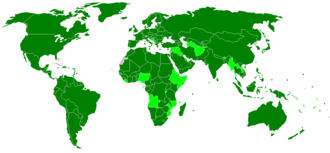
Not all member countries of the IMF are sovereign states, and therefore not all "member countries" of the IMF are members of the United Nations. Amidst "member countries" of the IMF that are not member states of the UN are non-sovereign areas with special jurisdictions that are officially under the sovereignty of full UN member states, such as Aruba, Curaçao, Hong Kong, and Macau, as well as Kosovo. The corporate members appoint ex-officio voting members, who are listed below. All members of the IMF are also International Bank for Reconstruction and Development (IBRD) members and vice versa.citation needed
Former members are Cuba (which left in 1964), and the Republic of China (Taiwan), which was ejected from the IMF in 1980 after losing the support of then United States President Jimmy Carter and was replaced by the People's Republic of China. However, "Taiwan Province of China" is still listed in the official IMF indices.
Apart from Cuba, the other UN states that do not belong to the IMF are Liechtenstein, Monaco and North Korea. However, Andorra became the 190th member on 16 October 2020.
The former Czechoslovakia was expelled in 1954 for "failing to provide required data" and was readmitted in 1990, after the Velvet Revolution. Poland withdrew in 1950—allegedly pressured by the Soviet Union—but returned in 1986.
Qualificationsedit
Any country may apply to be a part of the IMF. Post-IMF formation, in the early postwar period, rules for IMF membership were left relatively loose. Members needed to make periodic membership payments towards their quota, to refrain from currency restrictions unless granted IMF permission, to abide by the Code of Conduct in the IMF Articles of Agreement, and to provide national economic information. However, stricter rules were imposed on governments that applied to the IMF for funding.
The countries that joined the IMF between 1945 and 1971 agreed to keep their exchange rates secured at rates that could be adjusted only to correct a "fundamental disequilibrium" in the balance of payments, and only with the IMF's agreement.
Benefitsedit
Member countries of the IMF have access to information on the economic policies of all member countries, the opportunity to influence other members' economic policies, technical assistance in banking, fiscal affairs, and exchange matters, financial support in times of payment difficulties, and increased opportunities for trade and investment.

Comments
Post a Comment